
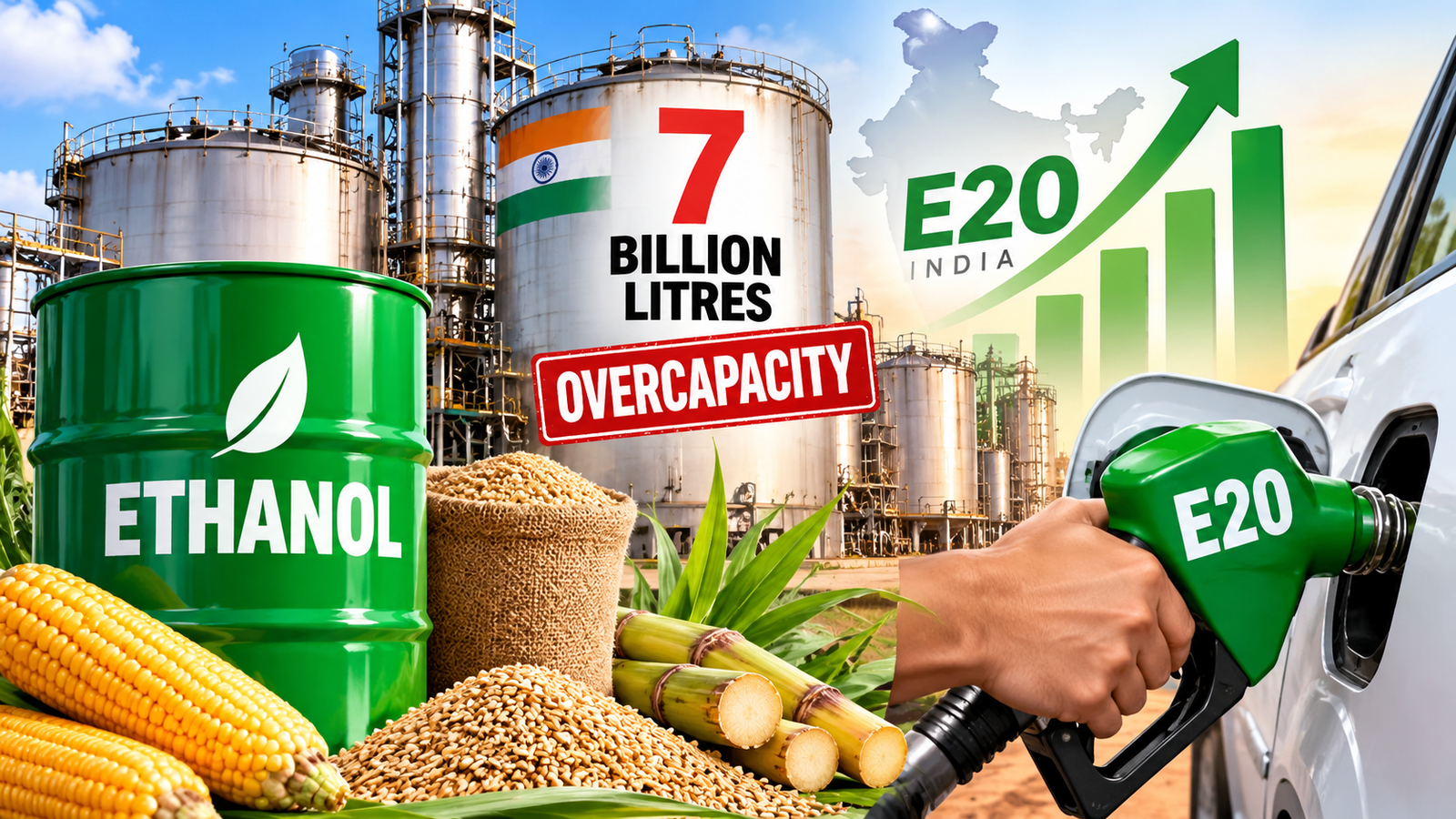
India faces a potential ethanol oversupply after achieving 20% petrol blending. Explore production capacity, E20 demand, grain-based ethanol, exports and the policy challenges ahead.
New Delhi. India’s ethanol programme is entering a new phase as the country moves from an era of capacity expansion to a potential supply glut. After years of rapidly scaling up production to meet ambitious blending targets, the industry is now confronting the possibility of significant ethanol oversupply, raising concerns over demand, storage, pricing, plant utilisation and the future of newly created distillery capacity. The challenge has emerged just as India has achieved its 20% ethanol blending target in petrol in Ethanol Supply Year (ESY) 2025-26—five years ahead of the original 2030 deadline. At the same time, ethanol production capacity has surged to around 2,000 crore litres in 2026 from about 421 crore litres in 2014, creating a widening gap between available capacity and the market’s ability to absorb additional volumes. With the industry also facing an estimated 7-billion-litre overcapacity, the key question now is not how fast India can produce ethanol, but where the additional supply will find a market.
From shortage to surplus
For several years, the central challenge for India’s ethanol programme was to create enough domestic capacity to meet the requirements of Oil Marketing Companies (OMCs). Government incentives encouraged sugar mills and standalone distilleries to expand capacity and diversify feedstocks.
That strategy has substantially increased domestic availability. According to the Department of Food and Public Distribution, ethanol production capacity had reached 1,953 crore litres as of October 31, 2025.
Industry participants have now pointed to a different problem: production capacity is growing faster than the domestic fuel-blending market can absorb additional volumes at the current E20 level. The Economic Times reported in July that India was producing more ethanol than it could consume under the existing market structure and that the industry was exploring export opportunities in neighbouring and other Asian markets.
Why E20 changes the equation
The completion of the E20 rollout has effectively changed the demand equation. Ethanol demand rose rapidly as blending increased from less than 1.5% in 2013-14 to 20% in 2025-26. Ethanol procurement by OMCs is projected to have crossed 1,200 crore litres in ESY 2025-26.
The key question now is: where will the additional ethanol go if domestic petrol blending remains capped at around 20%?
The government has clarified that there is currently no decision to increase nationwide petrol blending beyond 20%. Any future increase would require scientific and technical studies and consultations with automobile manufacturers, OMCs and research institutions.
This creates a potential demand-supply mismatch for producers that invested heavily in new distillation capacity on expectations of continued growth in ethanol demand.
Grain-based ethanol adds another dimension
The composition of ethanol production has also changed. The government says nearly three-fourths of India’s ethanol now comes from grains, particularly maize, while the share of sugar diverted towards ethanol has declined from about 12% in 2022-23 to around 9% in 2025-26.
This diversification has reduced the industry’s dependence on sugarcane-based feedstock. But it also means that ethanol demand is increasingly connected with the economics of maize and other grain markets.
For distilleries, therefore, the challenge is no longer simply producing ethanol. It is about securing offtake, managing feedstock costs and maintaining plant utilisation.
Export market could become an outlet
One possible solution is to develop an export market. Industry participants have discussed exports to countries such as Nepal, Bangladesh and Indonesia, where ethanol-blending programmes exist but domestic feedstock and distillation capacity may be more limited.
However, exports would expose Indian producers to international prices, freight costs, foreign exchange movements and the regulatory policies of importing countries.
India’s domestic fuel-ethanol policy currently relies on domestic production. The government also clarified in August 2026 that there was no concession or commitment to import US ethanol for fuel blending.
What happens to distilleries?
The emerging oversupply issue could become particularly important for distilleries that expanded capacity specifically to serve the EBP programme.
If domestic blending remains around 20%, producers will need additional outlets for ethanol through industrial applications, exports, chemical production and potentially other fuel applications.
The Supreme Court’s August 2026 order allowing OMCs to procure an additional 1.49 billion litres of ethanol for Q4 of ESY 2025-26 also underlines the importance of procurement arrangements and market access for producers.
Policy challenge ahead
India’s ethanol programme has delivered several policy objectives, including reducing dependence on imported crude oil, creating an additional market for agricultural feedstocks and improving the financial position of sugar mills.
The government estimates that the programme has helped substitute more than 310 lakh tonnes of crude oil and generated more than ₹1.60 lakh crore in additional farmer earnings since ESY 2014-15, while saving more than ₹1.90 lakh crore in foreign exchange.
But the next phase will be different. The central issue is shifting from capacity creation to demand creation and market optimisation.
If ethanol production continues expanding while domestic blending remains at E20, India could increasingly have to balance three options: expand alternative domestic uses, develop export markets or moderate further capacity expansion.
 Aman
Aman  Energy News