
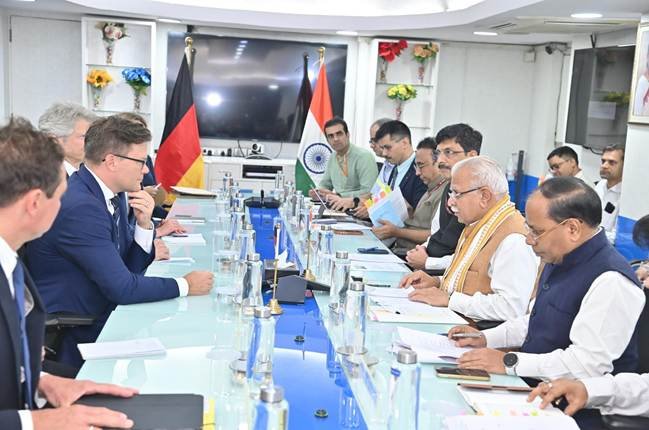
India and Germany deepen energy cooperation as Manohar Lal and Carsten Schneider discuss energy security, electrification, carbon markets, low-carbon development and supply-chain diversification.
New Delhi: Union Minister for Power and Housing & Urban Affairs Manohar Lal held a bilateral meeting with German Federal Minister for the Environment, Nature Conservation, Climate Protection and Nuclear Safety Carsten Schneider in New Delhi, with both sides discussing ways to further strengthen India-Germany cooperation in the energy sector.
The meeting focused on key areas including energy security, electrification, low-carbon development, carbon markets and diversification of supply chains, reflecting the growing importance of bilateral cooperation in the global energy transition.
Both ministers reviewed ongoing initiatives and explored new avenues for collaboration, building on the long-standing relationship between India and Germany. The discussions come as the two countries mark 75 years of diplomatic relations and 25 years of their Strategic Partnership.
Energy Security and Low-Carbon Development
Energy security emerged as one of the key areas of discussion during the meeting. Both sides agreed that energy security, low-carbon development and carbon markets are closely interconnected and that cooperation in these areas can reinforce each other.
India and Germany reaffirmed their shared commitment to developing an energy system that is secure, affordable and sustainable.
The discussions also highlighted the importance of electrification and the transition towards low-carbon energy systems. As India expands its electricity infrastructure and renewable energy capacity, cooperation with Germany could support technology, investment and policy collaboration across several areas of the energy transition.
Carbon Markets Gain Importance
Carbon markets were another important area discussed by the two ministers.
Carbon markets are increasingly becoming an important policy instrument in efforts to reduce greenhouse gas emissions while enabling industries to transition towards cleaner technologies.
India is developing its own Carbon Credit Trading Scheme (CCTS) as part of its broader strategy to reduce the carbon intensity of the economy. Cooperation with Germany and the European Union could provide opportunities for sharing experience in carbon-market design, emissions accounting and low-carbon industrial development.
The issue is particularly significant for energy-intensive sectors such as power, steel, cement, chemicals and other industries that are seeking to reduce their carbon footprint while maintaining competitiveness.
Diversification of Energy Supply Chains
The two sides also exchanged views on the need to diversify supply chains.
The global energy market has faced significant disruptions in recent years, highlighting the importance of resilient and diversified supply chains for energy technologies, critical minerals and other strategic resources.
For India, supply-chain diversification is increasingly important as the country expands renewable energy, electric mobility, energy storage and other clean-energy technologies.
Germany, meanwhile, is seeking greater resilience and diversification across its energy and industrial supply chains. This creates potential areas for deeper cooperation between the two countries.
India-Germany Strategic Partnership
The energy discussions form part of the broader strategic partnership between India and Germany.
The two countries have developed extensive cooperation across areas including energy, climate action, technology, trade, investment and sustainable development.
The latest meeting underlines the growing role of energy cooperation in the bilateral relationship, particularly as both countries seek to balance economic growth with climate objectives and energy security.
Both ministers agreed to maintain continued engagement in the coming months and work towards deepening cooperation across the identified areas.
For India, stronger cooperation with Germany could support efforts to build a secure, affordable and sustainable energy ecosystem, while providing opportunities for technology partnerships and investment in the country’s rapidly expanding energy sector.
For Germany, deeper engagement with India offers an opportunity to strengthen cooperation with one of the world’s fastest-growing major economies as global energy systems undergo a major transformation.
What It Means for the Energy Sector
The India-Germany dialogue comes at a time when energy security and the clean-energy transition are increasingly being viewed as complementary rather than competing priorities.
The focus on energy security, electrification, carbon markets, low-carbon development and supply-chain diversification indicates that future cooperation is likely to extend beyond renewable energy to include broader aspects of the energy transition.
The meeting therefore provides another platform for India and Germany to align their respective energy priorities while exploring opportunities for greater technological and economic cooperation.
The two sides’ shared emphasis on a secure, affordable and sustainable energy future is expected to keep energy and climate cooperation at the centre of the India-Germany strategic partnership.