
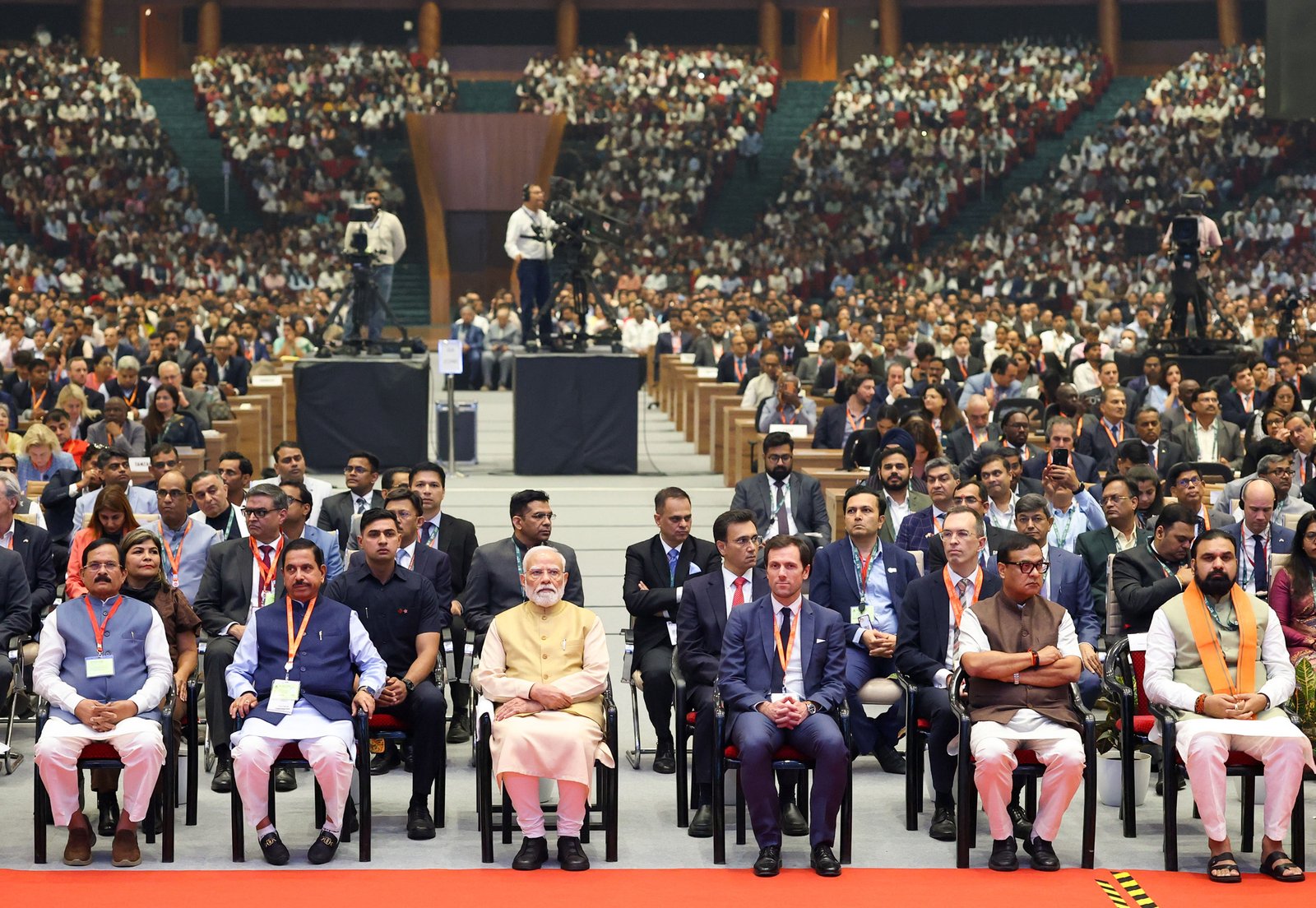
PM Modi inaugurates Bharat Renewable Energy Summit 2026, announces an additional 500 GW non-fossil energy target, highlights Rs 20 lakh crore investment opportunities and India’s renewable energy growth.
New Delhi: Prime Minister Narendra Modi on Monday inaugurated the Bharat Renewable Energy Summit & Expo 2026 at Bharat Mandapam, New Delhi, highlighting India’s growing leadership in renewable energy and outlining an ambitious roadmap for clean energy expansion. Addressing global industry leaders, investors, policymakers, startups and innovators, the Prime Minister said that energy security in the future would depend on clean energy, adding that India’s investments in renewable energy over the past decade had helped the country withstand global economic and geopolitical disruptions.
PM Modi said that despite major global challenges, including the COVID-19 pandemic and the ongoing West Asia crisis, India has maintained strong economic growth. He credited the country’s sustained investment in clean energy and structural reforms for strengthening its resilience against external shocks.
“If India had not invested in clean energy and created new systems for this over the past decade, then our crisis could have been much more severe than the rest of the world,” the Prime Minister said.
India Targets Additional 500 GW of Non-Fossil Energy Capacity
Highlighting India’s achievements in renewable energy, PM Modi said the country had fulfilled its commitment to achieve 50 per cent of installed electricity capacity from non-fossil fuel sources in 2025, five years ahead of its Paris climate pledge deadline.
India has already achieved nearly 300 GW of non-fossil energy capacity and crossed the 50 per cent mark in non-fossil installed power capacity. The Prime Minister said the country is now targeting an additional 500 GW of non-fossil energy capacity over the next 10 to 11 years.
He expressed confidence in India’s ability to achieve this ambitious target, stating that the country’s capabilities, technological progress and investment momentum would help accelerate the energy transition.
According to the Prime Minister, India is now among the world’s leading countries in solar and renewable energy development.
PM Surya Ghar Scheme Adds Over 65 Lakh Households
Highlighting the success of the PM Surya Ghar Muft Bijli Yojana, launched in February 2024, PM Modi said more than 65 lakh households have joined the rooftop solar initiative.
The scheme aims to install rooftop solar systems in one crore households across the country. According to the Prime Minister, around one lakh new households are joining the programme every six days.
He said the initiative has helped households reduce their electricity bills by approximately 76 per cent, while several families have brought their electricity bills down to zero. Some households are also earning additional income by selling surplus electricity to the power grid.
The Prime Minister said India’s rooftop solar model could serve as an example for other countries seeking to strengthen household-level energy security.
Solar Energy Helping Farmers and Government Institutions
PM Modi also highlighted the contribution of solar energy to agriculture and public infrastructure.
He said more than 44,000 government buildings have been connected with solar energy, generating annual savings of nearly Rs 700 crore.
Under the PM-KUSUM scheme, more than 30 lakh farmers have benefited from solar irrigation facilities. According to the Prime Minister, beneficiaries of solar pumps are saving nearly Rs 1 lakh annually.
He also referred to the PM Surya Sarovar Yojana, which promotes the installation of solar panels over reservoirs, ponds and lakes. Such projects can help generate renewable electricity while reducing the requirement for additional land acquisition.
The Prime Minister urged states and local bodies to accelerate solarisation of government buildings, schools, colleges, hospitals and streetlight networks.
Green Hydrogen to Become a Major Part of India’s Energy Strategy
The Prime Minister said India’s clean energy transition extends beyond solar, wind and hydropower, with green hydrogen emerging as an important component of the country’s future energy mix.
Under the National Green Hydrogen Mission, India aims to produce 5 million tonnes of green hydrogen annually by the end of this decade.
He also highlighted the country’s progress in green hydrogen-powered transportation, noting that India has started its first green hydrogen train.
The government is working to expand green hydrogen applications across industries and transportation to reduce dependence on conventional fossil fuels.
Rs 2 Lakh Crore Investment Target for Green Energy Corridors
Emphasising that renewable energy generation must be supported by an efficient transmission network, PM Modi highlighted the importance of Green Energy Corridors.
These corridors will help transfer electricity from solar and wind energy-rich regions to areas with comparatively lower renewable energy generation.
The Prime Minister said India is strengthening its national electricity transmission infrastructure through dedicated transmission lines, substations and the One Nation, One Power Grid framework.
He also referred to an investment target of approximately Rs 2 lakh crore to further strengthen the country’s power transmission infrastructure.
India’s Solar Manufacturing Capacity Crosses 200 GW
Highlighting the success of the Make in India and Atmanirbhar Bharat initiatives, PM Modi said India has made significant progress in domestic solar manufacturing.
Solar module manufacturing capacity has increased from around 2 GW a decade ago to more than 200 GW today. The country’s solar cell manufacturing capacity has also reached nearly 40 GW.
The Prime Minister said India had earlier depended heavily on imports for solar equipment and components, but domestic manufacturing has now expanded significantly.
He called for further strengthening indigenous manufacturing, battery storage technologies and next-generation clean energy solutions.
PM Modi Calls for Solar-Powered Homes and Agricultural Equipment
The Prime Minister urged startups, IITs, researchers and entrepreneurs to develop innovative solutions that can help households meet most of their energy requirements through solar power.
He suggested developing integrated solar-powered household models that combine rooftop solar electricity, solar cooking systems and charging facilities for electric two-wheelers and cars.
Such innovations, he said, could significantly reduce household expenditure and dependence on imported cooking gas.
PM Modi also called for developing specialised solar-powered equipment for the dairy and agriculture sectors, including machinery for animal fodder, crop harvesting and post-harvest activities.
He encouraged farmers to utilise vacant agricultural land and farm boundaries for solar installations instead of limiting solar adoption to irrigation pumps.
Renewable Energy Sector Attracts Rs 15 Lakh Crore Investment
Inviting global investors to participate in India’s renewable energy growth story, PM Modi said the sector has attracted investments exceeding Rs 15 lakh crore over the past decade.
Of this, more than Rs 6 lakh crore has been invested in the two years since the 2024 RE-INVEST Summit.
The Prime Minister said investment opportunities in India’s clean energy sector could exceed Rs 20 lakh crore by the end of this decade.
He highlighted India’s growing energy demand, large market size, policy stability and expanding manufacturing ecosystem as major advantages for domestic and international investors.
The Prime Minister also underlined the employment potential of the renewable energy sector, pointing to opportunities in solar panel manufacturing, installation, maintenance, transportation, battery production and associated industries.
India Proposes $200 Million Africa Solar Facility
Reaffirming India’s commitment to international clean energy cooperation, PM Modi highlighted the role of the International Solar Alliance and its efforts to expand solar energy access across developing countries.
He said India believes that finance, technology and expertise should reach every country that needs support in its clean energy transition.
In this direction, a proposal for a $200 million Africa Solar Facility has been put forward to support solar energy development across the African continent.
The Prime Minister said India’s renewable energy experience and technological innovations could benefit countries worldwide.
Concluding his address, PM Modi said the coming decade would be crucial for achieving global climate goals and building a clean, green and secure energy future
 Energy News